Posts

Intervention and (in)visibility: A comparative analysis of the Western Sahara conflict and Rojava revolution

Image
By Trent Tetterton Traditional scholarship has forced the trajectories of subnational movements such as uprisings, revolutions, and secessions into a reductive framework of understanding defined by “success” or “failure.” In the case of secession—a term functionally conceptualized as “an attempt by an ethnic group claiming a homeland to withdraw its territory from the authority of a larger state” and applied to movements both to create new states or increase regional autonomy (Horowitz 2011: 158-159) —, “success” has been considered the realization of a secessionist group’s aim. Such an outcome, scholars contend, has historically rested on effective external assistance and international recognition (Horowitz 2011: 159; Dugard and Raič 2006: 99; Fabry 2011: 251).     Yet, despite the arguable need to understand what leads to/detracts from “success,” in the traditional sense, some have challenged this focus. Schwedler, for example, argues that centering on success as state-...

Exile, Precariousness, and Subjectivity in Academia. Interview with Aslı Vatansever

Image
In this podcast, we talk to Aslı Vatansever, author of the book At the Margins of Academia. Exile, Precariousness, and Subjectivity (Brill, 2020) about academic precarity, political repression, and the possibility for resistance.  Aslı Vatansever (PhD, University of Hamburg, 2010) is a sociologist of work and social stratification with a focus on precarious academic labour. After she got dismissed from her position as associate professor and banned from public service in Turkey due to her participation in the Academics for Peace campaign in 2016, she has been hosted as guest researcher at various institutions in Germany and Italy.  Her ongoing research project at Bard College Berlin investigates forms of academic labour activism in Europe. Her books include Sources of Islamism in the Ottoman Empire (2010), Ready to Teach Anything. The Transformation of the Academic into Unskilled Worker (2015, co-authored with Meral Gezici-Yalçın), and At the Margins of Academia. Exile, Pr...

Suicide bombing as a method of political violence in the MENA region: A new research perspective

Image
  An Afghan police officer receives treatment for wounds sustained in a suicide bombing. Source: Wiki commons. By Sean McCafferty Introduction The prevalence of suicide Improvised Explosive Device (IED) attacks in the Middle East and North Africa (MENA) has drawn significant attention from academia. Although over the past 10 years the number of suicide bombings have proliferated, becoming a consistent feature of intra-state conflicts (AOAV, 2019), existing approaches to understanding political violence in the MENA region have not done enough to offer meaningful and non-Orientalist analysis. As a result, this piece argues that there is a pressing need to move in a new direction.   In the aftermath of 9/11 and the ensuing ‘War on Terror,’ academia became focused on the psychology of suicide bombers (Ward, 2018: 88), often concluding that this form of political violence is driven by cultural or religious factors indigenous to the MENA region. This overwhelming focus on individual...

A Gender Analysis of Western Media Narratives of the YPJ War against the IS

Image
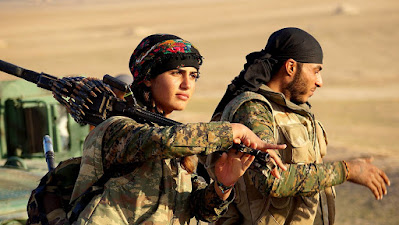
Asia Ramazan Antar,  who   was called " the Kurdish Angelina Jolie”  by global media during the war against the Islamis State. Source: Wikimedia Commons By Hoang Thi Kim Quy In the fight against the Islamic State (IS) group, the participation of Kurdish female fighters has attracted the attention of the global media and scholars. The significant contribution of the Women's Protection Units (YPJ)  received ample coverage by the Western media. However, such coverage represented specific and different characteristics to the one focused on male fighters. This article employs feminist studies of gender stereotyping  to analyse the Western media articulation of women's active role in this conflict. How do the Western media cover Kurdish female warriors Though Kurdish women have been pushing for political rights since the 1980s, the exposure of Kurdish women in the Western media has grown only since the enhanced visibility of their military capabilities during the...

Interview with Kohl journal

Image
We kick off our series of discussions on gender with an interview with the journal  Kohl. Sahar Ahmed, Paola Rivetti, Natasha Remoundou, and Nada Ahmed Mostafa Kamal Ahmed of Inmenas spoke to Ghiwa Sayegh and Sophie Chamas from the Body and Gender Research Journal, Kohl, about their interests, work, political and ethical preoccupations, and about running a journal during precarious times.  Kohl is a progressive, feminist journal on gender and sexuality in the Middle East, South West Asia, and the North Africa regions. It is a biannual, multilingual, open access, and peer-reviewed academic journal, targeting graduate-level academics, fresh graduates, independent writers, activists and researchers who are not affiliated with an academic institution. Ghiwa Sayegh is a queer feminist writer, publisher and archivist. She is the editor in chief of Kohl , a journal she has conceived, and the co-founder of Intersectional Knowledge Publishers. Ghiwa is a member of the collective RESUR...

Power and conflict versus the global development: a study of Iran-US relations

By Dr Amin Sharifi Isaloo This paper presents sociological and anthropological theories to examine the linkages between conflict and development, particularly the world power structures and interests which contribute to the continuation of violence within and between countries. Concentrating on the international relations, the purpose of this paper is to advance an understanding of global development in phases of conflicts and to discuss how conflicts affect development. In other words, a particular focus on the international tension is taken to illustrate destabilisation of global development by powerful states which leads the world into an uncertain future. In reaction to the welcome speech of US representative Adlai Stevenson, who reiterated the US commitment to helping African countries in the General Assembly, Jaja Anucha Wachuku who was first Nigerian ambassador and permanent representative to the United Nations in 1960, responded: Well, the West will have to pay for its decades ...